How My Dissertation Went Terribly, Wonderfully Wrong

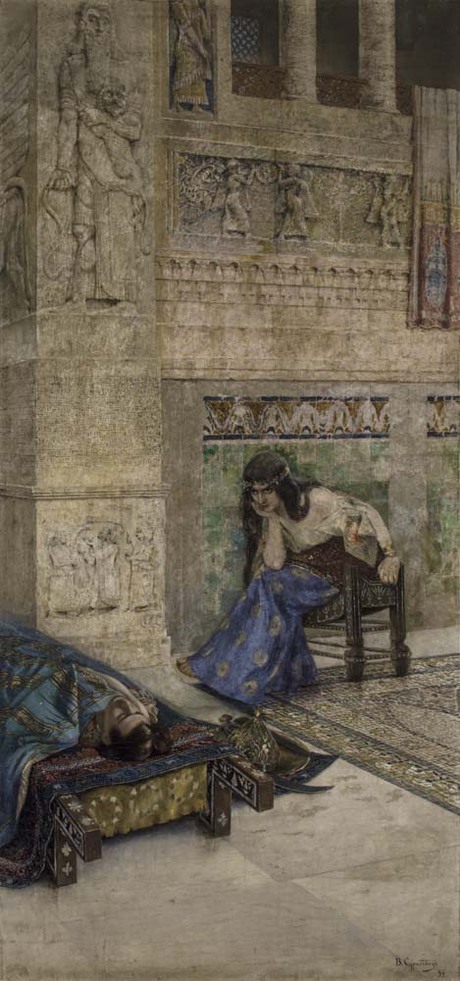
When I arrived at St. John’s University to begin my PhD in history, my plan was to be a modernist. In my application, I had enthusiastically proposed to study modern perceptions of Middle Eastern women. I labored under this plan for two full academic years, all the while fulfilling my coursework requirements.
One afternoon, I was sitting in the grad office—a modest little den at the entrance to our department’s narrow, quasi-Kubrickian hallway that had been set aside as a space for the graduate students to congregate, usually too loudly—when I was approached by a colleague who was a Byzantinist. He handed me a book that he had bent open to a page that referenced an Armenian text from the Byzantine Empire. “You know anything about this?”
I glanced at the page.
I stared at the page.
I had absolutely no idea what was on this page.
Armenia’s medieval past had rarely entered my mind up until that point in my life. I had some ambient understanding that, of course, Armenia had had a medieval past, and that parts of it were celebrated. What parts those were, I could not possibly articulate. I knew there was something about Mesrob Mashdots, and something about being the first Christian nation, and that was pretty much it. The legendary war hero Vartan Mamikonean? Forget it. No clue who that guy was. Imagine my embarrassment when I had to stare blankly back at my friend and shrug my shoulders. “No clue, dude,” I admitted to him sheepishly. Ahmot kezi, I could hear my mother’s voice shaming me in my mind’s ear. I was embarrassed, and that embarrassment motivated me to rectify the ignorance that had led me to that shame.
The next day, I began reading everything I could get my hands on about Armenia’s medieval history. I started, of course, with the most reliable scholarly source available to me: Wikipedia. From there, I mined citations and followed trails of footnotes from one source to another, and within weeks I was reading medieval Armenian chronicles in English translation (as I was surprised to learn, Armenia’s medieval language was nearly incomprehensible to me, and also Armenia had a medieval language apparently – this was news to me too): first the Buzandaran, then Movsēs Khorenatsʽi, and then another, and then another. As I kept reading, a question kept announcing its presence in the back of my mind: “What’s going on with women here? What’s their situation?” I then did something very dangerous: I began taking notes. (Side note: don’t ever do this while reading unless you have an extra 5-8 years to spend in grad school. It never ends any other way, I promise.)
As I continued reading and (yikes) taking notes, my initial questions about women were quickly supplanted by others. Something caught my eye in these chronicles that I had not anticipated: not just the ways in which they discussed women, but the ways in which they discussed women’s bodies. I began paying attention to this: a remark about female beauty here, a comment on childbirth there, and over there… something about the liver? What was going on here? I had to find out. I began even more studiously highlighting, annotating, and scribbling down notes. As I attended more and more to the ways these medieval historians discussed the female body, so too was I catching parallels in how they discussed the male body. The connections were unavoidable, and I realized that I wasn’t able to extricate the one from the other. Male and female bodies, I discovered, were being written about in the same ways by the same authors across hundreds of years of texts. “Now this is interesting!” I thought to myself.
I soon realized that I was no longer interested in women. I was interested in bodies: women’s, men’s, and—as it would turn out—eunuchs’ (although, as I came to learn from this work, eunuchs are decisively gendered male in medieval Armenian texts – this we can tackle in another piece). I kept at this for months. I remember going to my local coffee shop and sitting at the bar (the one with the really noisy chairs that hasten hearing loss by about three years every time you move them) with my interlibrary-loaned copy of the Buzandaran (Nina Garsoian’s translation, of course – the gold standard). I would gently maneuver around its thick yellow strap, open the five-pound tome, and meticulously pore over its descriptions of concubines, bestiality, and Vahan Mamikonean’s “virile member” (seriously, the text devotes an entire paragraph to this. It’s on p. 229, if you’re curious). Now blushing, I suspiciously peered up from my book to make sure no one could sense that I was engaged in such scandalous reading. Who knew that medieval documents could be so smutty? (Well, now I do, and I’ve made it my job to know!) Other body parts came up too: the nose, the testes, the uterus, and, of course, the liver. That liver thing would vex me until I dug far deeper into history to finally understand it (TL;DR: the ancients used to think of the liver like we now think of the heart).
By the time I got to the eighth century, it had finally hit me: this is my dissertation topic. After months of casual reading (well, as casual as reading about castration and incest can be), I realized that this is what I am truly interested in, and this is what my dissertation will be. My mind began to swirl. I thought to myself, “Am I actually going to be a medievalist of all things? I came to grad school to study 20th-century history. Am I really sure about this?” But it was too late. I had already fallen in love with this subject, with this material, with these characters and their stories. As an undergraduate history major, I never took a single class in medieval history. They simply weren’t offered at my college. “How am I possibly going to be a medieval historian,” I thought to myself as my heart pounded, “who has never taken a medieval history course?!”
I didn’t know the answer, but I knew I had to figure it out. There was simply no turning back. Now that I had fully sunken my teeth into this subject, nothing else would satisfy my curiosity. So I got to work. I began reading everything I could get my hands on about medieval history both within and beyond Armenia. I started studying Krapar, the classical written Armenian in which these texts had been composed. I recall saying to my mother, “Did you know about this?! Did you know we had a medieval language that was totally different from how we talk?!” She was more concerned with whether I wanted salad or pilaf with my luleh. What a silly question – the answer is always, of course, both. The following semester, I was assigned to teach World History I: Before 1500 by my department. “Oh good,” I thought to myself. “Throw me straight to the wolves.” This turned out to be a blessing. Nothing forces one to learn a topic like having to teach it. And both teach and learn it I did.
Ultimately, my dissertation’s central question concerned not modern history or even medieval women. Instead, it focused on the body as a literary proxy for identity. I argued that medieval Armenian writers used the body in their chronicles (and a handful of other genres) to attach moral values to ethnoreligious identity. The most salient distinctions were not between male and female bodies but, rather, between Armenian bodies and non-Armenian bodies – largely irrespective of gender. Armenian Christian bodies, they would profess, are naturally virtuous and pure. Other people’s bodies? Hideous, sexually deviant, probably diseased. What about when an Armenian does something morally objectionable with their body? Off with their head! (Or at least they can’t come to church for a little while.)
Despite my moments of panic, I couldn’t be more grateful that my medievalist colleague approached me that day in the grad office, as the Keurig sputtered and the printer hummed, to ask me about something I had never heard of before. My advice, then, is this: be curious. Follow that question mark that gnaws at you. It might lead you down unexpected paths that dazzle and excite you, and perhaps even shape your life for the better.
Or it might lead you to demon orgies and bags full of severed foreskins. (Reading about them, that is. If it leads you literally to those things, something has gone terribly wrong.) And who cares if all your friends think your weird obsession with medieval gonads is unhealthy? It’s your life. We all have our own janaparh to follow.
_____
Ashley Bozian, Ph.D. is an Adjunct Professor of History at the Department of History at St. John’s University. Her monograph based on her dissertation entitled Gender and the Sexualized Body in Medieval Armenia is under contract with Palgrave Macmillan.